
In late 2025, a geopolitical battle over a seemingly unremarkable chip company sent shock waves through the automotive world — and rippled all the way down to the humble collision repair shop. As disruption spreads beyond factories to service bays and parts shelves, body-shop owners need to start planning now.
The spark which triggered a global supply-chain shock
On 30 September 2025, the government of the Netherlands invoked emergency national-security legislation to seize control of Nexperia — a major supplier of automotive-grade semiconductors — from its Chinese parent company, Wingtech. Officials claimed previous leadership posed a long-term threat to European semiconductor capabilities.
Within days, China retaliated: exports from Nexperia’s major packaging and testing plant in Dongguan were halted, effectively cutting off a critical link in the production of tens of billions of “commodity” chips used across modern cars — from power-control circuits to sensors and body electronics.
Even though some deliveries resumed in early November after diplomatic manoeuvring, the disruption had already exposed how fragile the global automotive supply chain is — especially for the electronic components that many repair shops don’t even think about until they get stuck.
Why this matters for collision repair shops
At first glance, a chip shortage might seem like an abstract problem for carmakers — but in fact it touches directly on the day-to-day of any collision repair operation. Here’s how:
Essential modules may take longer to arrive. Many vehicle parts used in modern body and safety systems — window regulators, central-locking modules, seat controls, lighting, airbag sensors — rely on the simple chips supplied by Nexperia. With production bottlenecks and export restrictions, supplies of these modules (new OEM replacements) may slow or halt, stretching lead times for repairs.
Prices for parts likely to rise, or payment/ordering friction. When supply tightens, costs go up. Suppliers and OEMs already face pressure to qualify alternatives; that often comes with higher costs or longer lead times.
More jobs will require module re-conditioning, coding or used part sourcing. With delays or unavailability of new electronic modules, repair shops may need to turn to salvaged/re-programmed modules — a process more labour-intensive and technically demanding than a simple bolt-on part swap.
Customer and insurer frustration grows — and shops may get squeezed. Delays in getting parts may force longer rental car periods, slower turnaround times, and more back-and-forth with insurers. Shops that fail to plan for the disruption risk damage to reputation or even increased write-offs if insurers decide to declare vehicles total losses rather than wait.
Changing mix of workload — and demand. If new cars take longer to build, some owners may hold onto older cars longer. That could increase demand for third-party collision repair on older vehicles — albeit with fewer OEM-fresh parts available.
What repair shops should do — getting ahead of the problem
The current situation isn’t just a “wait and see” event — it calls for concrete action. Here are some recommendations for collision repair shops to proactively manage the risk:
Identify which parts you rely on that might be affected. Focus on modules and components that embed those “commodity” chips (e.g. BCMs, window-control modules, seat controllers, lighting, sensors). Flag the most commonly used SKUs and review recent part-order history.
Where possible, build a small buffer stock of critical parts. If cash and storage allow, keeping one or two of the most frequently ordered control modules in inventory can prevent shop-stopping delays.
Start forging relationships with salvage yards and used/re-programmed module suppliers. Used or re-manufactured modules could become a vital workaround — but only if you have reliable suppliers and the tools to re-code or program them.
Invest in diagnostic capabilities and technician training. Proper module diagnosis, coding, calibration — whatever is required for re-programmed or non-OEM components — will pay off if new module supply remains unstable.
Review your labour-time estimates and pricing policies. Increased sourcing complexity, part-hunting, programming, and communication overhead should be captured as separate billable items (e.g. “sourcing and programming fee”).
Communicate clearly with customers and insurers from the outset. Set expectations early about possible delays or alternative parts sourcing; get authorisation for substitute strategies (used parts, extended lead times, potential additional cost).
Watch developments closely and stay nimble. The supply-chain disruption began as a political and trade dispute. Its course is uncertain — and resolution (or further disruption) could come quickly. Use OEM bulletins, supplier alerts, and industry news to stay ahead.
A fragile supply chain — and an opportunity
What this crisis underscores is a sobering reality: even “low-tech” chips — the unglamorous diodes, transistors, MOSFETs, logic ICs that power simple functions — are foundational to modern cars. When their supply breaks, the whole chain rattles.
For many collision repair shops, this disruption poses a serious threat to workflow and profitability. But it also presents an unusual opportunity: shops that adapt early — by stocking critical parts, building salvage/re-use networks, boosting diagnostic and programming capabilities — can come out stronger. They may become not just repair shops, but vital repair-network hubs for insurers, fleets, and car owners that need timely solutions when supply dries up.
In a volatile global supply environment, planning, transparency, and operational flexibility will be what separates shops that get caught flat-footed — from those that thrive. The chips may be small. The consequences are not.

Staff Writer
Reporting from the front lines of the collision repair industry, delivering expert analysis and the technical updates that drive the African automotive sector forward.
More From News
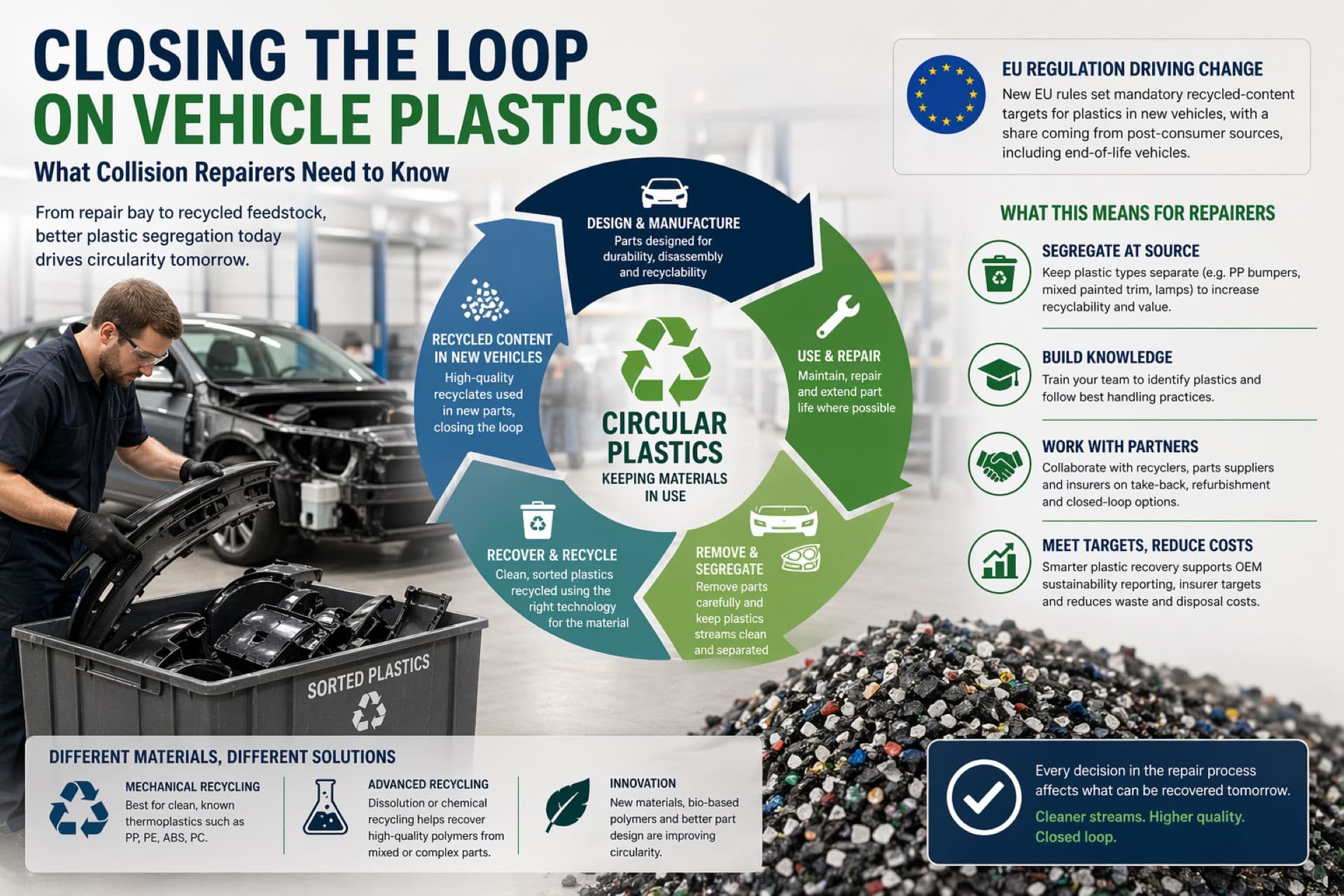
Closing the Loop on Vehicle Plastics: What Collision Repairers Need to Know
New EU rules are pushing vehicle makers and repairers toward plastics circularity, with rising recycled content targets and better end-of-life recovery

Zimbabwe Delegation Explores BAIC’s Role in Regional Automotive Growth
Zimbabwe’s automotive leaders visit BAIC South Africa to explore manufacturing, skills development, and regional industry collaboration.

What are SDVs and what do they mean for collision repair?
Software defined vehicles, or SDVs, are vehicles in which software rather than fixed hardware determines how most systems operate. Functions such...

Fuel price shock prompts insurer action to support South Africa’s repairers
South Africa’s motor body repair sector is under growing strain as sharp fuel price increases push operating costs higher, prompting some insurers...

KwaZulu-Natal’s Automotive Momentum looked at
Durban’s Automechanika CEO Breakfast highlighted KZN’s rising automotive role, export growth and EV investment, plus aftermarket development.

We Buy Cars Drives Youth Employment
South Africa’s challenge of youth unemployment remains pressing, but targeted initiatives are beginning to show tangible results. We Buy Cars, in...